
Do Dates Help With Labor? What the Research Says
Maybe, but nobody has proven it. Some studies of date fruit link eating dates in late pregnancy with more dilation on arrival at the hospital and less induction, but the quality of that evidence varies widely, and dates are not proven to induce labor.
If you're here at 37 weeks wondering about dates for labor, you've probably seen the "six dates a day" advice, and heard from people who swear by it and people who noticed no difference at all. So we read the studies, including the parts that don't make it into most articles.
You should know two things first. We sell a date smoothie mix, so we have a stake in this topic. And every study below used date fruit, not our product or any date powder blend.
The short version
- The headline finding is a link, not proof. A 2024 review pooled studies of date fruit and found that women who ate dates in late pregnancy had more dilation on admission and less induction. The same review called the overall evidence quality "unacceptable" and said risk of bias was high in most studies.
- The better trials don't fully agree. Two trials rated low risk of bias tested date fruit in late pregnancy. One saw more spontaneous labor. The other saw no difference.
- C-section results were not statistically significant in the pooled data.
- Safety data is thin. Only 4 of the 48 studies in that review looked at side effects.
- Gestational diabetes changes the conversation. Please talk to your provider before adding dates if you have it.
The main studies at a glance
Here are the main studies, with their limits. All of them studied date fruit in the forms and amounts shown, not this product or any date powder blend.
A quick key: latent phase is early labor. Augmentation means oxytocin to strengthen contractions. Bishop score is a measure of how prepared the cervix is for labor. Open label means everyone knew who was eating dates. Risk of bias is reviewers' rating of how much a study's design could skew its results.
| Study | Design and size | Dates and timing | What was reported | Main limits |
|---|---|---|---|---|
| Al-Kuran 2011, Jordan | Prospective, not randomized. 69 ate dates, 45 did not | 6 dates a day (60-67 g per the 2024 review) for the 4 weeks before the due date | Dilation on admission 3.52 vs 2.02 cm. Spontaneous labor 96% vs 79%. Induction or augmentation drugs 28% vs 47%. Latent phase 510 vs 906 minutes. Delivery outcome "more favourable, but non-significant" | Not randomized, so the groups may have differed in other ways. Authors called for a randomized trial |
| Razali 2017, Malaysia | Randomized. 154 first-time moms (77 and 77), uncomplicated pregnancies | 7 dates, about 80 g a day, from 36 weeks per the 2024 review | Less oxytocin augmentation. No significant difference in spontaneous labor. A longer "intervention to delivery interval". Most other outcomes, including dilation on admission, not significantly different, per the 2024 review | Open label. Rated low risk of bias overall |
| Kordi 2017, Iran | Called randomized by its authors, but one draw assigned days of the week to each group, and that schedule stayed fixed. Another review calls it quasi-randomized. 210 enrolled, 182 analyzed. First-time moms | 6-7 dates a day from week 37 | Dilation on admission 4.05 vs 2.54 cm. Spontaneous labor 94.5% vs 41.3%. Oxytocin 5.5% vs 48.7%. Shorter active phase, second and third stages | Not double-blind. 28 women removed after enrollment (11 date group, 17 control), with exclusions including under 2 weeks of dates and cesarean. Rated high risk of bias. Published as three papers, but one trial |
| Hiba 2022, Pakistan | Randomized by lottery. 140 first-time moms (70 and 70), low risk | 7 dates a day from 35 weeks | Spontaneous labor 84.2% vs 61.4%. Oxytocin 32.8% vs 51.4%. Dilation on admission 2.47 vs 1.60 cm. Latent phase 4.87 vs 8.04 hours. Second stage 50 vs 85 minutes. Third stage 11.8 vs 14.4 minutes. First stage not significantly different (p=0.07). Mode of delivery not significantly different (p=0.08) | Single hospital. No masking. Registered after the study ended, and the registry differs from the paper on size (142 vs 140) and start (37+ vs 35 weeks). Rated low risk of bias |
| Ahmed 2018, Saudi Arabia | Randomized per its authors, open label. 89 women, 3 groups | 7 dates, once in labor, not in late pregnancy | First stage 210 and 224 vs 362 minutes. Third stage: published means were longer in the date groups (5.45 and 5.50 vs 2.17 minutes), though the authors describe the result as favorable. The paper doesn't explain the mismatch. No significant difference in dilation or contractions | Small. Tests eating during labor, a different question |
| Sagi-Dain 2021 | Meta-analysis of 4 articles (the 2024 review counts these as 3 studies) | Late pregnancy | Dilation 1.1 cm higher. Induction or augmentation risk ratio 0.6. Latent phase 4.6 hours shorter. Second stage 7.7 minutes shorter. Authors say results "point to beneficial effects" | Authors: quality "weak due to high risk of bias" |
| Bagherzadeh Karimi 2020 | Meta-analysis of randomized and quasi-randomized trials (8 reports of 6 trials) | Late pregnancy and labor | Active phase 109 minutes shorter. Bishop score 2.45 points higher. No effect on first, second or third stage length or on cesarean rate | Authors: low to moderate quality |
| Salajegheh 2024 | Review of 48 studies: 15 randomized, 33 not | Third trimester, late pregnancy, labor and postpartum | See the next table | Authors: evidence quality "unacceptable", risk of bias high in most studies |
| Cleveland Clinic NCT07058792 | Randomized, no masking. 200 enrolled | 3 Medjool dates a day from 34 weeks | Primary outcome: spontaneous labor. Finished May 13, 2026. No results posted as of November 5, 2026 | Results unknown. Excluded diabetes and gestational diabetes |
Do dates induce labor?
No study has established that eating dates brings on labor. Some report more women going into labor on their own, but the two low-bias trials disagree. All of these trials used date fruit, not our product or a powder blend.
Razali's randomized trial concluded dates did "not expedite the onset of labour." Hiba's randomized trial, rated the same quality, reported more spontaneous labor in the date group. Pooled together, the 2024 review reported a higher rate. A statistical check for missing negative studies flagged that result, though the authors' follow-up correction didn't change it. The review also notes an earlier meta-analysis that found no significant effect (risk ratio 1.05). Pregnancies in its date groups were about 2 days shorter (1.97), and that stopped being statistically significant when one study (Kordi) was removed.
So the honest answer is that it hasn't been shown. If your provider has talked with you about induction, dates are not a substitute for that conversation or for that care. And if you ate dates and still needed an induction, you didn't do anything wrong. Nobody knows whether dates change this for any one person.
What the pooled numbers actually show
The 2024 Salajegheh review is the largest we found. These are its results for eating date fruit in late pregnancy. The last column shows what happened when the authors took out one study at a time, which moved results in both directions. Numbers in parentheses are the 95% confidence interval, the range the result plausibly falls in.
| Outcome | Pooled result, date groups vs. standard care | What changed when studies were removed |
|---|---|---|
| Length of pregnancy | 1.97 days shorter (0.69 to 3.24) | Not significant without Kordi |
| Cervical dilation on admission | 1.15 cm higher (0.25 to 2.05) | No single study drove it. Effect was larger in lower-quality studies |
| Bishop score | 2.47 points higher (2.00 to 2.94) | Only 3 studies, though no single study drove it |
| Need for induction | Risk ratio 0.48 (0.39 to 0.60) | No single study drove it and studies didn't vary much, but the review says the randomized trials heavily influenced it. Quality still limits it |
| Spontaneous labor | Risk ratio 1.32 (1.11 to 1.56) | No single study drove it. Effect was larger in lower-quality studies, and Razali on its own found no difference |
| Latent (early) phase | 214 minutes shorter (131 to 296) | Only 3 studies. No single study reported as driving it |
| Active phase | 68 minutes shorter (14 to 122) | Not significant without Karimian |
| First stage | 55 minutes shorter (31 to 79) | 5 of 6 studies were non-randomized. No single study reported as driving it |
| Second stage (pushing) | 15 minutes shorter (-1 to 31) | Not statistically significant. Became significant (19 minutes shorter, 2 to 36) only when Razali, a low-bias trial, was removed |
| Third stage | 1.2 minutes shorter (0.3 to 2.1) | Not significant without Kordi |
| Spontaneous vaginal birth | Risk ratio 1.09 (1.01 to 1.18) | Not significant without Hiba |
| Instrumental delivery | Risk ratio 0.37 (0.09 to 1.46) | Not statistically significant. No change reported |
| Cesarean | Risk ratio 0.75 (0.55 to 1.01) | Not statistically significant. Became significant when either of two studies (Razali or Karimian) was removed, so this result is unstable. It doesn't show dates prevent C-sections |
| Baby's outcomes | Too little data to pool | Most were not significantly different |
A risk ratio under 1 means less often in the date group, and over 1 means more often. These numbers describe groups in studies of date fruit. They can't tell you what will happen in your labor, and they have not been established for a date powder blend.
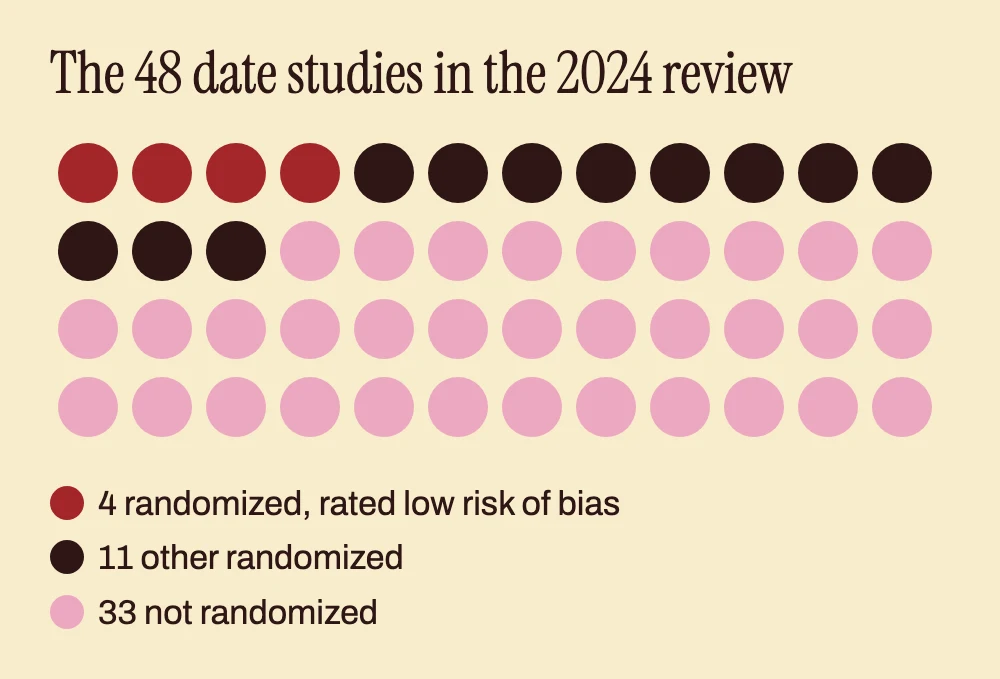
Why the quality problem matters
Forty-eight studies is the biggest body of research on dates and labor we found. Here's what's inside it:
- 33 of the 48 were not randomized, which makes it harder to know whether dates made the difference or the groups were just different.
- The authors read their results as promising, and they also call for better trials. Their abstract calls overall quality "unacceptable", while the body grades most outcomes low or moderate.
- Only 4 randomized trials were rated low risk of bias. Just two of those (Razali and Hiba) tested eating dates in late pregnancy. The others tested dates during labor and after birth.
- Lower-quality studies tended to show bigger effects on dilation and spontaneous labor, according to the review's comparison of study groups.
- Not all 48 are about labor. Some looked at anemia in the third trimester or breast milk after birth. Fifteen tested dates over 1 to 8 weeks in late pregnancy.
- None were in the United States. Thirty were in Indonesia and nine in Iran. The authors point out that dates are a dietary staple in many of these places, and ask for trials where they aren't. A US trial has since finished at Cleveland Clinic, but its results aren't posted.
- None reported using powder. The forms reported were whole fruit, juice or syrup, and one study didn't say.
A 2025 paper on date fruit ranked high on Google for this topic when we wrote this, and we've seen it shared online as if NIH had endorsed it. Being on PubMed Central doesn't mean that: its disclaimer says inclusion does not imply endorsement. This paper describes itself as retrospective. Its abstract reports a "significant" effect, but the paper shows no test or control-group figures to support it, and its results describe a different number of groups than its methods do. We don't give it weight here.
How and why do dates help with labor, if they do?
Nobody knows yet. Papers on date fruit suggest several ideas: an oxytocin-like effect on the uterus, fatty acids involved in making prostaglandins, or simply the energy from the sugar. These are explanations offered by authors, and the trials above weren't designed to test them. In the 2024 review, two of three studies that measured contractions found no significant differences. None of this has been studied for our product or a powder blend.
Are dates safe? What about blood sugar and gestational diabetes?
Dates are an ordinary food, but they haven't been studied much in this situation. In the 2024 review of date fruit, the four trials that looked for side effects reported none, and the authors still called the safety of this practice, especially in late pregnancy, "questionable" because so little was measured. None of these trials tested our product or a powder blend. That's why we wouldn't repeat the common line that there's no evidence of downsides.
Now, blood sugar:
- The 2024 review gives its own caution. It warns that daily dates may be troublesome with gestational or pre-existing diabetes because of the high sugar content. It also notes an assumption that more than two dates at a time substantially raises blood glucose in women giving birth, while other studies disagree. It calls these reports controversial and says dates should be used in a set amount under a care team's supervision.
- It's a lot of sugar. USDA data lists Medjool dates at 66.5 g of sugar per 100 g and Deglet Noor at 63.4 g. By our math, the 60-80 g a day used in most late-pregnancy trials comes to about 38-53 g of sugar a day.
- Studies outside pregnancy don't settle this. One study measured glycemic indices of 46 to 55 in small groups of healthy adults and adults with type 2 diabetes, using single portions of varieties that didn't include Medjool or Deglet Noor. A randomized trial assigned 100 adults with type 2 diabetes to three dates a day or no dates for 16 weeks and found no change in HbA1c, but that's about half the number of dates in most labor trials. A pilot in 10 healthy adults looked only at fasting glucose. None tells you what dates do to your blood sugar after a meal in pregnancy.
- People with gestational diabetes are largely missing from the labor research. The 2024 review excluded women with a history of high-risk pregnancy or serious antenatal problems, so this gap likely runs across all 48 studies. The randomized late-pregnancy trials we read enrolled low-risk or uncomplicated pregnancies, and the Cleveland Clinic trial excluded diabetes and gestational diabetes outright. We found no trial of dates in women with gestational diabetes. The Cleveland protocol includes a glucose check after eating dates on delivery day, in women without diabetes, which may eventually add some data.
If you have gestational or pre-existing diabetes, or you've been told to watch your blood sugar, please talk to your provider or dietitian before adding dates or any date product.
What we know, what we don't
| What we can reasonably say | What we don't know |
|---|---|
| Women who ate date fruit in late pregnancy were more dilated on admission in several studies | Whether dates caused that, or how much of it is study quality |
| Pooled data shows less induction in date groups | Whether the same would hold in larger, well-run trials, including in the US |
| Some trials reported shorter early labor | Whether the second stage changes. Meta-analyses differ, and it wasn't statistically significant in the largest one |
| Cesarean differences were not statistically significant | Whether there is any real effect on how babies are born. That result is unstable |
| No side effects were reported in the 4 trials that looked | Whether that holds for more women, since 44 of 48 studies didn't report on it |
| Most studies used about 6-7 dates (60-80 g) a day | The best amount, type or start date. The review couldn't identify one for late pregnancy |
| Cleveland Clinic's randomized trial has finished | What it found |
| All of this concerns date fruit | Whether any of it applies to date powder. No study we found tested it |
When to start, and how many
The main late-pregnancy trials of date fruit above started between 35 and 38 weeks, while the Cleveland Clinic trial started at 34. We go through the timing in when to start eating dates in pregnancy. Amounts and varieties get their own guide: how many dates a day, Medjool vs. Deglet Noor. In short, trials count grams more reliably than dates, because sizes vary a lot. Cleveland's three Medjool dates come to about 72 g at USDA's 24 g per date, inside the older trials' range. Either way, run your plan by your provider.
If you've already decided to eat dates
Then the hard part is usually the daily part. We started Fruits of Labor because we didn't enjoy plain dates, didn't have the energy to keep preparing them, and found it hard to keep up every day.
Labor Support Blend, Chocolate Date Roast is our way of making a daily date habit easier: two scoops blended with about a cup of ice and ¾ cup of milk. It's a smoothie mix, not a treatment, and it isn't a reason to skip a conversation with your provider.
The above findings concern date fruit consumption in the studied forms and amounts. They have not yet been established specifically for a date powder blend.
For a shorter summary of the evidence, see our research page, or browse more on the blog.
Frequently asked questions
Do dates actually help with labor? Some studies of date fruit, not of this product or any powder blend, report links with more dilation on admission and less induction, but quality varies and results are mixed. It isn't proven, and the largest review called for better trials.
Can dates induce labor? This hasn't been shown. In studies of date fruit, not of any powder blend, one randomized trial concluded dates did not bring on labor sooner, and another reported more spontaneous labor. Don't rely on dates to start labor or to avoid medical care.
Do dates make you dilate faster? Studies of date fruit mostly measured how dilated women were on admission, not how fast they dilated. Several reported more dilation in date groups, but others, including Razali's late-pregnancy trial and one trial of dates eaten during labor, found no significant difference. None tested a powder blend.
How many dates does it take to induce labor? There's no such number, because dates aren't shown to induce labor. For the amounts studies of date fruit used, and why they don't translate to a recommendation, see our how many dates a day guide. These studies used date fruit, not this product or a powder blend.
When should I start eating dates for labor? No start date has been shown to be best. Studies of date fruit, not of any powder blend, mostly began between 35 and 38 weeks, and no study tells us whether 37 weeks or later is too late. Our timing guide has more. Ask your provider what makes sense for you.
What kind of date is best for labor? No one knows. Many studies of date fruit didn't report the variety, and no type has been shown to work better for labor outcomes overall. These studies used date fruit, not this product or a powder blend.
Can I eat dates if I have gestational diabetes? Ask your provider or dietitian first. Dates are high in sugar, the largest review of date fruit studies warns they may be troublesome with gestational diabetes, and we found no labor trial that studied women who have it. These studies used date fruit, not this product or a powder blend.
Do these studies apply to date powder? Not directly. The studies reported using whole dates, juice or syrup. Dried powder grams also aren't the same as whole-date grams, so study amounts don't translate neatly.
What if I'm past my due date? Talk to your provider. It's a medical conversation, and dates aren't a substitute for monitoring or recommended care.
This article is general information, not medical advice. Please talk with your OB or midwife about what's right for your pregnancy.
Sources
- Al-Kuran O, et al. The effect of late pregnancy consumption of date fruit on labour and delivery. J Obstet Gynaecol. 2011;31(1):29-31. https://pubmed.ncbi.nlm.nih.gov/21280989/
- Razali N, et al. Date fruit consumption at term: Effect on length of gestation, labour and delivery. J Obstet Gynaecol. 2017;37(5):595-600. https://pubmed.ncbi.nlm.nih.gov/28286995/
- Kordi M, et al. Effect of dates in late pregnancy on the duration of labor in nulliparous women. Iran J Nurs Midwifery Res. 2017;22(5):383-387. https://pmc.ncbi.nlm.nih.gov/articles/PMC5637148/
- Hiba N, et al. Effect of date fruit consumption in later pregnancy on length of gestation, labour and delivery of nulliparous women. Pak Armed Forces Med J. 2022;72(6):2082-2086. https://www.pafmj.org/PAFMJ/article/view/8122
- Ahmed IE, et al. Effects of date fruit consumption on labour and vaginal delivery in Tabuk, KSA. J Taibah Univ Med Sci. 2018;13(6):557-563. https://pmc.ncbi.nlm.nih.gov/articles/PMC6695006/
- Sagi-Dain L, Sagi S. The effect of late pregnancy date fruit consumption on delivery progress: A meta-analysis. Explore (NY). 2021;17(6):569-573. https://doi.org/10.1016/j.explore.2020.05.014
- Bagherzadeh Karimi A, et al. Effects of date fruit (Phoenix dactylifera L.) on labor and delivery outcomes: a systematic review and meta-analysis. BMC Pregnancy Childbirth. 2020;20:210. https://pmc.ncbi.nlm.nih.gov/articles/PMC7157989/
- Salajegheh Z, et al. Is oral consumption of dates (Phoenix dactylifera L. fruit) in the peripartum period effective and safe integrative care to facilitate childbirth and improve perinatal outcomes: a comprehensive revised systematic review and dose-response meta-analysis. BMC Pregnancy Childbirth. 2024;24:12. https://doi.org/10.1186/s12884-023-06196-y
- El-Ardat MA, et al. The effects of date consumption on labor and vaginal birth. Med Arch. 2025;79(1):56-60. https://pmc.ncbi.nlm.nih.gov/articles/PMC12045585/
- Cleveland Clinic. Impact of Medjool Date Consumption on Labor and Delivery Outcomes. NCT07058792. https://clinicaltrials.gov/study/NCT07058792
- Alkaabi JM, et al. Glycemic indices of five varieties of dates in healthy and diabetic subjects. Nutr J. 2011;10:59. https://pubmed.ncbi.nlm.nih.gov/21619670/
- Alalwan TA, et al. Effects of daily low-dose date consumption on glycemic control, lipid profile, and quality of life in adults with pre- and type 2 diabetes: a randomized controlled trial. Nutrients. 2020;12(1):217. https://pubmed.ncbi.nlm.nih.gov/31952131/
- Rock W, et al. Effects of date (Phoenix dactylifera L., Medjool or Hallawi variety) consumption by healthy subjects on serum glucose and lipid levels and on serum oxidative status: a pilot study. J Agric Food Chem. 2009;57(17):8010-8017. https://pubmed.ncbi.nlm.nih.gov/19681613/
- USDA FoodData Central. Dates, medjool (FDC ID 168191) and Dates, deglet noor (FDC ID 171726). https://fdc.nal.usda.gov/
- National Library of Medicine. PMC disclaimer. https://pmc.ncbi.nlm.nih.gov/about/disclaimer/