
When to Start Eating Dates in Pregnancy
Most studies of eating dates in the weeks before labor had women start around 36 or 37 weeks, so that is the usual time to begin if dates are part of your labor prep. We found no study that compared start dates, so there is no proven best week, and dates are an everyday food you can generally eat earlier too, unless your provider has told you otherwise.
One caution about that window: the authors of a major 2024 review specifically called for research on whether eating date fruit before 37 weeks could bring on preterm labor. That hasn't been answered, so bring it up with your provider if you're thinking of starting before 37 weeks.
We started Fruits of Labor after struggling through plain dates in our own pregnancies, often guessing whether we'd eaten the right amount. The last thing you need before labor is more labor, so let's get this onto your calendar.
Please run your plan by your healthcare provider, especially if you have gestational diabetes or another condition. All research below concerns dates themselves, mostly whole dates and in a few studies date juice, and never a powder or blend, including ours.
Find your start date from your due date
Count back from your due date. 36 weeks is 28 days before it, 37 weeks is 21 days before, and 38 weeks is 14 days before.
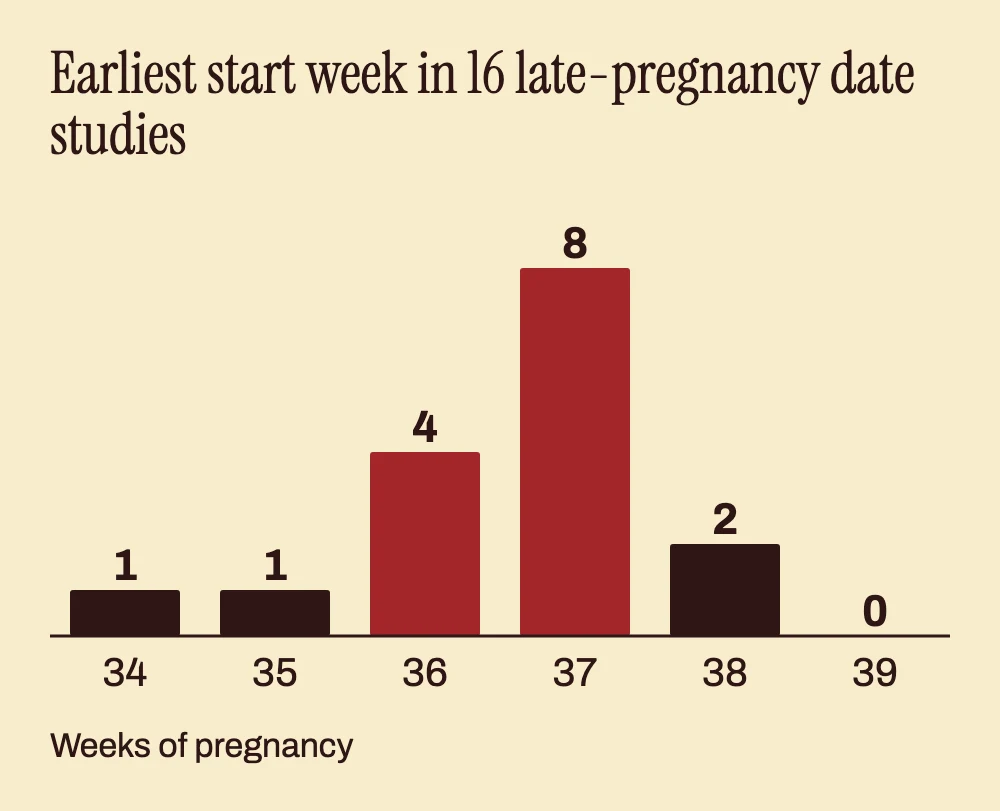
Here's a January 15, 2027 due date, with how often each start week appears in the research.
| Start at | Days before due date | If due Jan 15, 2027 | Studies with this earliest start* |
|---|---|---|---|
| 34 weeks | 42 | Dec 4 | 1 |
| 35 weeks | 35 | Dec 11 | 1 |
| 36 weeks | 28 | Dec 18 | 4 |
| 37 weeks | 21 | Dec 25 | 8 |
| 38 weeks | 14 | Jan 1 | 2 |
| 39 weeks | 7 | Jan 8 | 0 |
*Our own count of the 16 late-pregnancy studies listed in a 2024 systematic review. Half listed a range of weeks, so we counted the earliest. 13 of the 16 used whole dates and 3 used date juice. One of the two 38-week studies measured breast milk, with no labor outcomes listed.
What this table can't tell you:
- More studies does not mean better. Eight studies with 37 weeks as their earliest start show what researchers tended to choose. They don't show that 37 beats 36, and the review's authors could not identify an optimal duration for most outcomes.
- Your due date is an estimate. ACOG describes it as a guide based on an average 280-day pregnancy. Your baby has not read this table, so the real total could be more or less.
Why 36 or 37 weeks?
Mostly because that's when researchers had women start. In the review's 16 late-pregnancy studies, 12 listed 36 or 37 weeks as their earliest start, and the others ranged from 34 to 38 weeks. Only five of the 16 were randomized, and those started anywhere from 35 to 38 weeks.
Two examples, both using whole dates:
- A 2011 study in Jordan compared 69 women who ate six dates a day for four weeks before their due date with 45 who ate none. It wasn't randomized, so other differences between the groups could explain some of what it found.
- A 2017 randomized trial in Malaysia followed 154 first-time moms with uncomplicated pregnancies. The review lists its start as 36 weeks. The date group needed less labor augmentation, but labor was no more likely to start on its own.
In practice, women ate them for less time than the calendar suggests. One Iranian trial, reported in several papers, started at 37 to 38 weeks, and the review lists about 19 days of eating dates on average.
Some of this research reported encouraging findings, and some did not. The same review called the overall evidence quality unacceptable, with ratings mostly low to moderate, found high risk of bias in most studies, and asked for better-designed trials. A smaller 2021 meta-analysis also rated its included studies as weak. We go through the details in Do Dates Help With Labor? and on our research page.
Timing itself is barely studied. A randomized Cleveland Clinic trial had women eat three Medjool dates a day from 34 weeks, compared with no dates, so it can't settle which week is best. Its record lists 200 participants and a May 2026 completion date, with no results posted when we checked on November 5, 2026.
The above findings concern date fruit consumption in the studied forms and amounts. They have not yet been established specifically for a date powder blend.
What to do, week by week
Here's how dates during pregnancy can fit in at each stage, and where the research on dates (not powder blends) runs out.
| When | What makes sense | What we don't know |
|---|---|---|
| Before 34 weeks | Enjoy dates as food if you like them. No daily plan needed. | None of the 16 late-pregnancy studies started this early, so any effect on labor, including preterm labor, is untested. |
| 34 to 35 weeks | Raise your plan and the preterm labor question at a prenatal visit. Try a few ways of eating them and find one you can stand. | Only two of the 16 studies started here. One was a small study of date juice. |
| 36 to 37 weeks | The most common start in the research, if you and your provider are on board. Before 37 weeks, ask about the preterm labor question. | Whether 36 is better than 37. No trial has tested one against the other. Comparing across studies, the 2024 review saw stronger results for date fruit in studies of women at 37 weeks or later, but said that may just reflect how many of those studies there were. |
| 38 to 39 weeks | Not too late to start if you'd like to. One whole-date labor study began at 38 weeks. | Whether a shorter stretch matters. See the FAQ below. |
| Past your due date | Fine to continue if you've been enjoying them. Dates don't replace medical care or a recommended induction, and ACOG notes testing or induction may come up around 41 weeks. | Whether continuing makes any difference. |
Yes, dates have real sugar
We make a date product, and we still won't pretend otherwise. Here's what USDA data shows:
| Amount | Sugars | Total carbs | Fiber | Calories |
|---|---|---|---|---|
| 3 Medjool (about 72g) | 48g | 54g | 4.8g | 199 |
| 10 Deglet Noor (about 71g) | 45g | 53g | 5.7g | 200 |
| 6 Medjool (about 144g) | 96g | 108g | 9.6g | 399 |
| 6 Deglet Noor (about 43g) | 27g | 32g | 3.4g | 120 |
Notice the last two rows. "Six dates a day" means very different things depending on the date. Many whole-date studies worked with about 60 to 80 grams a day, which is closer to three Medjools than six. How Many Dates a Day? covers amounts and types.
You may read that dates are low glycemic. Here's what sits behind that:
- What was tested. Small studies measured some date varieties as low glycemic, including one with 13 healthy adults and 10 with type 2 diabetes. A 2023 review found values from 42.8 to 74.6 by variety.
- Who was left out. None of those were studies of gestational diabetes. Date-and-labor trials have also tended to leave out higher-risk pregnancies, and the Cleveland Clinic trial excluded diabetes and gestational diabetes outright.
- What's known on safety. Only four of the 48 studies in the 2024 review recorded safety, and only two of those involved eating dates daily in late pregnancy. The four reported no side effects, yet the authors still called safety in late pregnancy an open question.
Have diabetes of any kind, including gestational? This is one to clear with your care team first. The 2024 review's authors say daily dates might be troublesome for you because of the sugar, and that dates should be eaten under a care team's supervision. ACOG's advice for gestational diabetes centers on tracking your blood sugar, eating regular meals, and often having two to three snacks a day, so any dates need to fit inside that plan. ACOG also says blood sugar is usually tested between 24 and 28 weeks, so you'll likely have that result before your start date arrives.
Check first too if a doctor has you limiting fiber, if fructose upsets your stomach, if you have a food allergy, or if you've been told you're at risk of preterm labor.
How to start without making it a part-time job
- Weigh your dates once. Put a typical portion on a kitchen scale so you know what your dates add up to. After that, you can go by count.
- Ease in. Dates add fiber fast. Starting with one or two a day for a few days is a comfort idea of ours, not something the studies tested.
- Split it up. A couple of studies split the daily amount into two or three sittings. It may feel easier if you have heartburn, though that's our own idea and wasn't tested.
- Pair them. Pregnancy forums keep coming back to the same ideas: stuffed with nut butter, chopped into oatmeal, warmed with milk, or blended into a smoothie.
- Brush or rinse afterward. They're basically edible glue with sugar in it.
- Plan for fatigue. Plain dates get old quickly. We know.
That's why we made Labor Support Blend, Chocolate Date Roast. Minimal labor required: blend two scoops with about a cup of ice and ¾ cup of milk. Each serving is made with 6+ dates' worth of organic whole date powder and has 20g of protein. That isn't a match to any amount in the studies, because powder and whole dates haven't been compared. A pouch covers about two weeks of daily smoothies (15 servings). The label lists 58g of total carbs and 43g of total sugars, 0g added, per serving before you add milk, so the sugar advice above applies here too. Check with your provider first. Our blend hasn't been studied for labor outcomes or blood sugar. The research above used date fruit and juice, not this product.
Frequently asked questions
Is 34 weeks too early for dates?
Not as a food, for most people, but talk through a daily plan first. One small study started at 34 weeks using date juice, and a Cleveland Clinic trial started Medjool dates at 34 weeks, with no results posted. The authors of a 2024 review called for research on whether eating date fruit before 37 weeks could bring on preterm labor. That hasn't been answered, so bring it up with your provider. None of this research used a date powder blend.
Can I eat dates at 32 weeks pregnant?
Eating dates during pregnancy as part of a normal diet is generally fine, unless your provider has advised otherwise. The late-pregnancy studies of date fruit and juice didn't begin that early, and none tested a powder blend, so there's no labor-related research reason to start a daily plan yet. A 2024 review also called for research on date fruit before 37 weeks and preterm labor, so ask your provider if you're considering it.
Is it too late to start at 38 or 39 weeks?
No. One labor study of whole dates, not a date powder blend, began at 38 weeks. There's less to go on. A 2024 review of date fruit studies looked for a link between how long women ate dates and how long labor lasted and didn't find one, but said the data were too limited to settle it.
Will eating dates make me go into labor early?
We can't promise anything either way. A 2017 randomized trial of whole dates found no significant difference in length of pregnancy. A 2024 review pooled four whole-date studies and reported pregnancies about two days shorter on average, but that result leaned on one trial and the evidence was weak overall. The authors also called for research on whether date fruit before 37 weeks could bring on preterm labor, which hasn't been answered, so raise it with your provider if you'd start before then. None of this research used a date powder blend. Treat dates as a food, not a way to induce labor.
How many dates should I eat a day?
Studies of whole date fruit, not powder blends, commonly used around 60 to 80 grams a day, and size matters more than count. See How Many Dates a Day? for the full breakdown.
Can I eat dates if I have gestational diabetes?
Possibly, but make that decision with your provider or dietitian. Even a modest portion has a lot of sugar and carbs, and date fruit has not been well studied in gestational diabetes. Powder blends haven't been studied for this at all.
When should I start eating dates and drinking raspberry leaf tea?
For dates, most late-pregnancy studies of date fruit, not a powder blend, started around 36 or 37 weeks, and a 2024 review flagged an open question about preterm labor before 37 weeks. Raspberry leaf tea is a separate question with separate evidence, so ask your provider. We'd rather not guess at it here.
The bottom line
If you and your provider decide dates fit your pregnancy, 36 or 37 weeks is where most of the research started, and a little later isn't a failure. Before 37 weeks, ask about the preterm labor question. Then count back from your due date, set a reminder, and pick a way of eating them you won't dread. There's more third-trimester reading on our blog.
This article is general information, not medical advice. Talk with your healthcare provider about your own pregnancy.
Sources
- Salajegheh Z, et al. Is oral consumption of dates (Phoenix dactylifera L. fruit) in the peripartum period effective and safe integrative care to facilitate childbirth and improve perinatal outcomes: a comprehensive revised systematic review and dose-response meta-analysis. BMC Pregnancy and Childbirth, 2024.
- Al-Kuran O, et al. The effect of late pregnancy consumption of date fruit on labour and delivery. J Obstet Gynaecol, 2011.
- Razali N, et al. Date fruit consumption at term: Effect on length of gestation, labour and delivery. J Obstet Gynaecol, 2017.
- Sagi-Dain L, Sagi S. The effect of late pregnancy date fruit consumption on delivery progress: a meta-analysis. Explore, 2021.
- Cleveland Clinic. Impact of Medjool Date Consumption on Labor and Delivery Outcomes, NCT07058792. ClinicalTrials.gov.
- Alkaabi JM, et al. Glycemic indices of five varieties of dates in healthy and diabetic subjects. Nutrition Journal, 2011.
- Meenakshi S, Misra A. Effect of dates on blood glucose and other metabolic variables: A narrative review. Diabetes Metab Syndr, 2023.
- ACOG. Gestational Diabetes and When Pregnancy Goes Past Your Due Date.
- USDA FoodData Central, SR Legacy: Dates, medjool (FDC ID 168191) and Dates, deglet noor (FDC ID 171726).