
How Many Dates a Day? Medjool vs. Deglet Noor
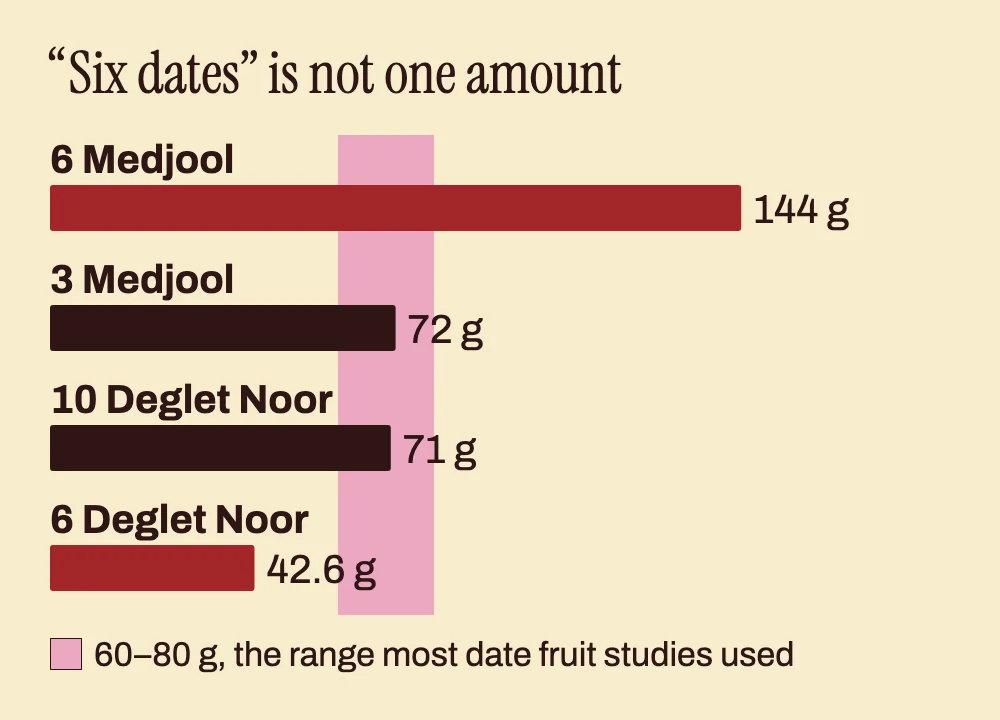
There is no agreed number of dates to eat a day in pregnancy, but the studies behind the advice mostly used about 60 to 80 grams of date fruit a day. By USDA weights, that's about 3 Medjool dates or about 10 Deglet Noor, not six of either.
That is why "six dates a day" causes so much confusion. If you have been choking down six giant Medjools every day, you can stop feeling like you're failing at snacks. You may have been eating about twice what those studies used.
This is a look at what the research used (whole date fruit, not our blend or any powder). It isn't a dose for you, so please run any daily date plan past your healthcare provider.
Where "six dates a day" came from
The phrase is often linked to a small 2011 study from Jordan, where women ate six date fruits a day for the four weeks before their due date. Salajegheh and colleagues' 2024 review of 48 date studies lists that amount as 60 to 67 grams a day. Six dates and 60 to 67 grams only go together if each date is about 10 to 11 grams. USDA's averages for Medjool and Deglet Noor both sit outside that size.
| Study | Design | Dates per day | Grams per day | Grams per date (our math) | Type reported |
|---|---|---|---|---|---|
| Al-Kuran 2011, Jordan | Not randomized, 69 women ate dates, 45 did not | 6 | 60-67 | 10-11.2 | Fully ripe (tamer), variety not reported |
| Razali 2017, Malaysia | Randomized, 154 women | 7 | 80 | 11.4 | Fully ripe (tamer), variety not reported |
| Kordi 2013-2017, Iran | Clinical trial, 182 women analyzed | 6-7 | Within 60-80 | About 10-12 | Bam Mazafati, softer rutab stage |
| Cleveland Clinic, USA (no results posted yet) | Randomized, 200 women enrolled | 3 | Not stated | About 24 by USDA | Medjool |
The Al-Kuran and Razali gram figures are as listed in Table 2 of Salajegheh 2024. Those papers' abstracts don't state grams, and the review's figures may be estimates.
The 2024 review describes most late-pregnancy studies as using 6 to 7 dates, or 60 to 80 grams, a day. It also says there is no standard dose. We use 60 to 80 grams below as a yardstick. It isn't a target.
Every study here used date fruit. None used this blend or any other powder. Whatever these studies found applies to date fruit in the forms and amounts they used, and has not yet been established specifically for a date powder blend.
Results are mixed and the overall quality of the evidence is low, which we walk through in Do Dates Help With Labor? What the Research Says. For the calendar question, see When to Start Eating Dates in Pregnancy.
Medjool vs. Deglet Noor: the math
USDA's FoodData Central lists a pitted Medjool at 24 grams and a pitted Deglet Noor at 7.1 grams. A Medjool is about 3.4 times the size.
- Medjool: 60 ÷ 24 = 2.5 dates, and 80 ÷ 24 = 3.3 dates. Six dates is 6 × 24 = 144 grams.
- Deglet Noor: 60 ÷ 7.1 = 8.5 dates, and 80 ÷ 7.1 = 11.3 dates. Six dates is 6 × 7.1 = 42.6 grams.
| What you eat | Weight | Compared with 60-80 g | Calories | Sugars | Fiber |
|---|---|---|---|---|---|
| 6 Medjool | 144 g | 64-84 g more (about double) | 399 | 95.7 g | 9.6 g |
| 3 Medjool | 72 g | In that weight range | 199 | 47.9 g | 4.8 g |
| 60-80 g Medjool (2.5-3.3 dates) | 60-80 g | In that weight range | 166-222 | 39.9-53.2 g | 4.0-5.4 g |
| 6 Deglet Noor | 42.6 g | 17.4-37.4 g less (53-71% of that weight) | 120 | 27.0 g | 3.4 g |
| 10 Deglet Noor | 71 g | In that weight range | 200 | 45.0 g | 5.7 g |
| 60-80 g Deglet Noor (8.5-11.3 dates) | 60-80 g | In that weight range | 169-226 | 38.0-50.7 g | 4.8-6.4 g |
Calculated from USDA values per 100 g. Medjool: 277 calories, 66.47 g sugars, 6.7 g fiber. Deglet Noor: 282 calories, 63.35 g sugars, 8.0 g fiber. Example: 144 × 0.6647 = 95.7 g sugars. USDA's Medjool nutrient values come from only 2 samples, and real dates vary, so treat these as averages. Grams also don't capture ripeness, so these figures may not match the sugar or calories of the dates in any given study.
You may have seen the tidy rule "3 Medjool or 6 Deglet Noor." The first half holds up. The second does not, at least at USDA's average weight: six Deglet Noor come to about 43 grams, well short of 60.
Dates do vary. The two Deglet Noor trials in the 2024 review, both postpartum, are listed at about 10 grams a date, and at that size six would be about 60 grams. That's the reason to weigh your own box instead of trusting anyone's count, ours included.
For scale, ACOG puts extra calorie needs at about 450 a day in the third trimester. Six Medjools would use up most of that.
What kind of dates did the labor studies use?
If you are in the grocery aisle wondering what kind of dates to eat for labor, here is what we can tell you about which box the research used: probably neither. Most papers in the 2024 review did not name a variety. Among those that did, Bam Mazafati was the most common, followed by Sukari and Ajwa. The only Deglet Noor trials we found in its table were postpartum, and it listed no Medjool studies. All of it was date fruit, not our blend.
That may change. A Cleveland Clinic trial was set up to give women 3 Medjool dates a day, and the registry lists it as completed in May 2026, with no results posted as of its last update. We last checked on November 5, 2026.
We didn't find a study comparing Medjool and Deglet Noor head to head. Per 100 grams, USDA has the two looking a lot alike, with slightly more fiber in Deglet Noor and slightly more sugars in Medjool. In practice:
- Medjool: soft, sticky and caramel-like. Fewer dates to get through.
- Deglet Noor: firmer and less rich. More dates, but each one is a small commitment.
- Whatever you will actually eat: pick the one you'll still eat in week two.
Mixing types is fine for the math, as long as you remember it's only math. One trial in that range used a softer, earlier-stage date, and the review notes that ripeness substantially changes a date's sweetness and makeup. So 3 Medjools can match a study by weight, and not necessarily by sugar or calories.
The kitchen check: how to weigh your dates
USDA's numbers are averages, and your box may differ. A kitchen scale settles it in about a minute.
- Pit the dates first, since USDA's weights are for pitted fruit. The papers we could read don't say whether trial weights included pits.
- Put a small bowl on the scale and zero it.
- Add dates until you reach the amount you and your provider are comfortable with.
- Count them. That is your number for this box.
- Pack that many into a container for the week, so you only have to do this once per box.
No scale? Divide the box's net weight by the number of dates. If yours still have pits, the number will run a little high.
Blood sugar: the real numbers
Dates are fruit, and they are also a lot of sugar. Three Medjools carry about 48 grams of sugars and about 54 grams of total carbohydrate. Six carry nearly 96 grams of sugars.
You may read that dates are low on the glycemic index. One small study did measure GIs of about 44 to 55 for five date varieties, across 13 healthy adults and 10 adults with type 2 diabetes. The authors saw no significant spikes in the diabetic group, who were managing their diabetes with lifestyle or metformin. It wasn't a pregnancy study, and neither Medjool nor Deglet Noor was tested. GI also describes how a food behaves per gram of carbohydrate. It says nothing about how much you are eating. That study fed 50 grams of available carbohydrate, and three Medjools come to about 49 grams after subtracting fiber.
The pregnancy evidence is thin here. Only 4 of the 48 studies in the 2024 review evaluated side effects. Those four reported none, which the authors don't treat as settling it. These studies looked at date fruit, not our blend. The authors call regular date intake potentially troublesome for people with pre-pregnancy or gestational diabetes, note conflicting reports, and call for more safety data. Some studies also leave out the people with the most at stake: Razali enrolled uncomplicated pregnancies, and the Cleveland Clinic trial excluded diabetes and gestational diabetes.
ACOG says that with gestational diabetes, healthy food choices matter even more for keeping blood sugar from running high, along with regular meals and tracking your levels.
If you have gestational diabetes, diabetes or have been told to watch your blood sugar, talk to your provider before adding dates at any of these amounts. The same goes for a date smoothie or date powder.
Making the amount doable
We started Fruits of Labor because we didn't love plain dates, ran out of energy to dress them up, and kept wondering whether we'd eaten the right amount. Moms in online forums swap these workarounds:
- Split them, some in the morning and some later.
- Stuff them with peanut butter, or pair them with something savory.
- Dice them into oatmeal.
- Soak them in hot water, then blend them into a smoothie, which keeps your blender on speaking terms with you.
Where a date powder blend fits
Our one product is Labor Support Blend, Chocolate Date Roast, made for the days you can't face another sticky date. Blend 2 scoops with about a cup of ice and ¾ cup of milk.
Each serving is made with 6+ dates' worth of whole date powder. As this whole article shows, "a date" isn't one size, so that isn't a match to any study amount. The label lists 43 grams of total sugars and 0 grams of added sugars per serving, along with 310 calories, 58 grams of carbohydrate, 10 grams of fiber and 20 grams of protein, with the milk on top.
The research used date fruit, not this blend or any date powder, and nothing it found has yet been established specifically for a date powder blend. A serving is still a real amount of sugar, so the blood sugar advice above applies here too. You can read more on our research page or browse the blog.
FAQ
Is 3 dates a day enough in pregnancy?
It depends on the date. Three Medjools come to about 72 grams, in the range many studies used. Three Deglet Noor come to about 21 grams, much less than that. A few small, lower-quality studies listed around 3 dates, roughly 40 grams. Those studies used whole dates, not our product. We didn't find one that established a minimum, so ask your provider what makes sense for you.
How many Medjool dates per day did the studies use?
Most of the studies didn't use Medjools, or didn't say. By weight, 60 to 80 grams is about 2.5 to 3.3 Medjools. A Cleveland Clinic trial planned 3 a day, but its results aren't posted yet. Those studies used whole dates, not our product.
How many Deglet Noor dates equal 3 Medjools?
About 10 at USDA's averages of 7.1 and 24 grams each. Individual dates vary, so weigh yours once.
Is 2 dates a day too much?
Two Medjools have about 32 grams of sugars and two Deglet Noor about 9. The 2024 review repeats a caution that more than two at a time may raise blood sugar substantially, though it's stated as an assumption and date size isn't given. That review covers whole dates, not our product. If you have been told to watch your blood sugar, ask your provider.
How many dates can I eat in pregnancy?
We didn't find an established upper limit. The late-pregnancy studies mostly stayed around 60 to 80 grams a day, and safety wasn't well measured. Those studies used whole dates, not our product. Your provider can factor in your blood sugar and the rest of your diet.
Do I still count dates if I'm using date powder?
Don't count dried powder grams as whole-date grams, because whole dates contain water. The studies also used the fruit, so their findings can't be assumed to apply to a powder.
This article is general information, not medical advice. Talk with your healthcare provider before making changes to your diet in pregnancy.